When I grow my own account with GrowTweet, the account itself becomes the demo.

Shahin, founder of GrowTweet
Dhaka, Bangladesh
A 99helpers Maker Interview
Conversations with independent makers about how they make, host and market the things they build — and the lessons they learned along the way. See all interviews
Make
Host
Market
The product
GrowTweet
growtweet.space
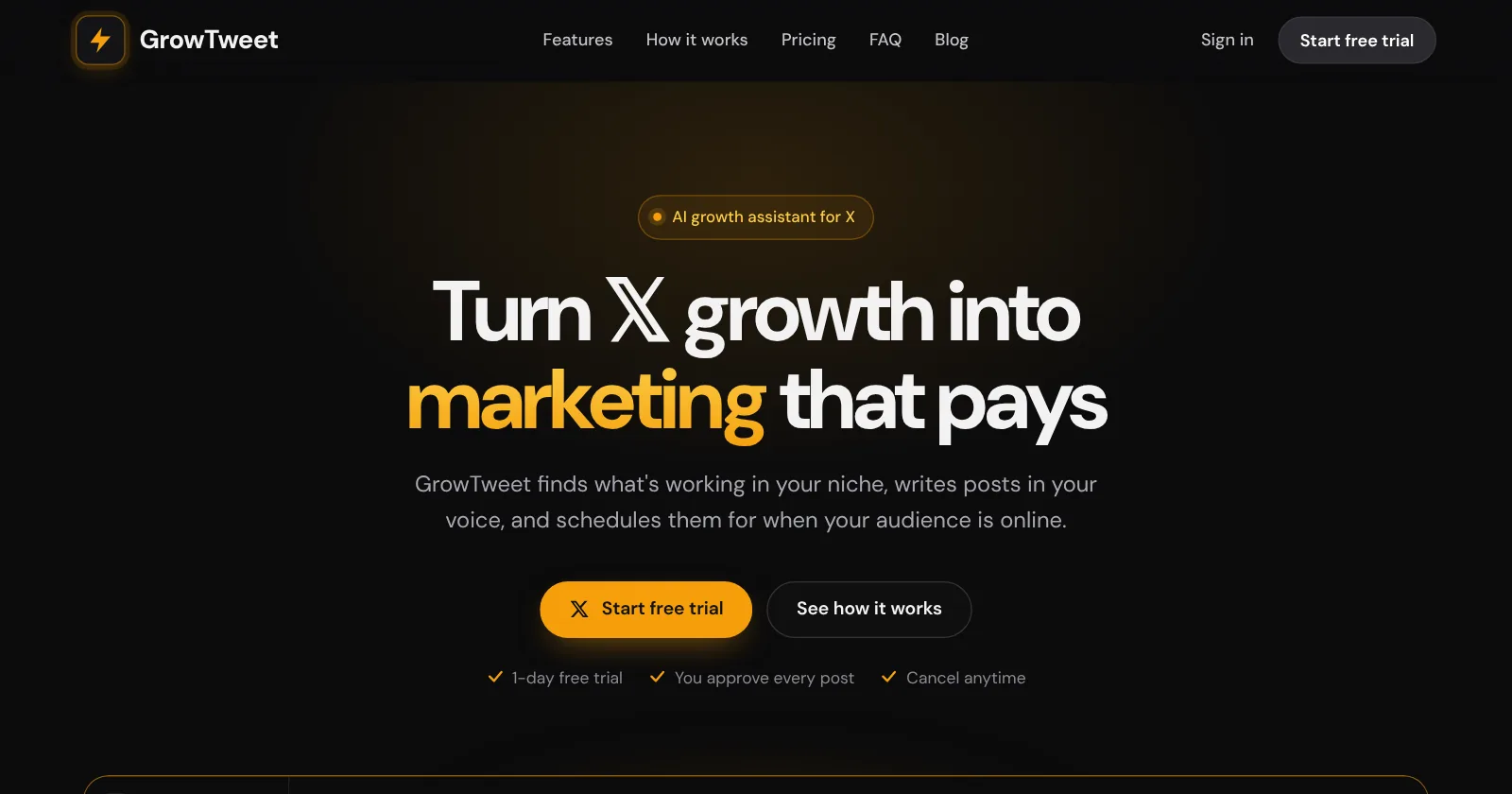
An AI-powered growth tool for X. It finds what's going viral in your niche and turns it into ready-to-post content written in your own voice.
Features, pricing and more in Maker Products01
Who are you, and what did you build?
I'm Shahin, an independent creator and indie developer based in Dhaka, Bangladesh. Most of my work so far has been in templates. I run Studio KOVA, which has 55+ Webflow and Framer templates on the Webflow Marketplace. I also build an Android study app called Sharos and run a YouTube channel, Artifactal AI.
GrowTweet (growtweet.space) is an AI-powered growth tool for X. It finds what's going viral in your niche and turns it into ready-to-post content written in your own voice. It can also schedule and publish that content for you on autopilot.
02
Why did you build it?
It started as a personal frustration. Distribution has always been the hardest part of everything I build. I could ship templates and apps, but getting people to see them was a different problem. X is the obvious place for indie makers, but growing there takes a lot of daily effort. You have to keep up with what's trending, figure out which formats work, write posts every day, and post them at the right times.
I tried the existing tools. Most of them were schedulers with an AI text box bolted on, or generic writers whose posts sounded like nobody in particular. I wanted one tool that would show me what's working in my niche right now and then write in my voice about it, not in "AI voice." So I built it for myself first, and the plan was always to use GrowTweet to grow my own account before selling it to anyone else.
“Most of them were schedulers with an AI text box bolted on, or generic writers whose posts sounded like nobody in particular.”
03
Why should people use your product?
GrowTweet is for indie hackers, founders, creators and small brands who know they should be posting on X consistently but don't have hours a day to do it.
What it does differently:
Discover
shows you the viral posts in your specific niche, so you're working from real signals instead of guessing.
Trends
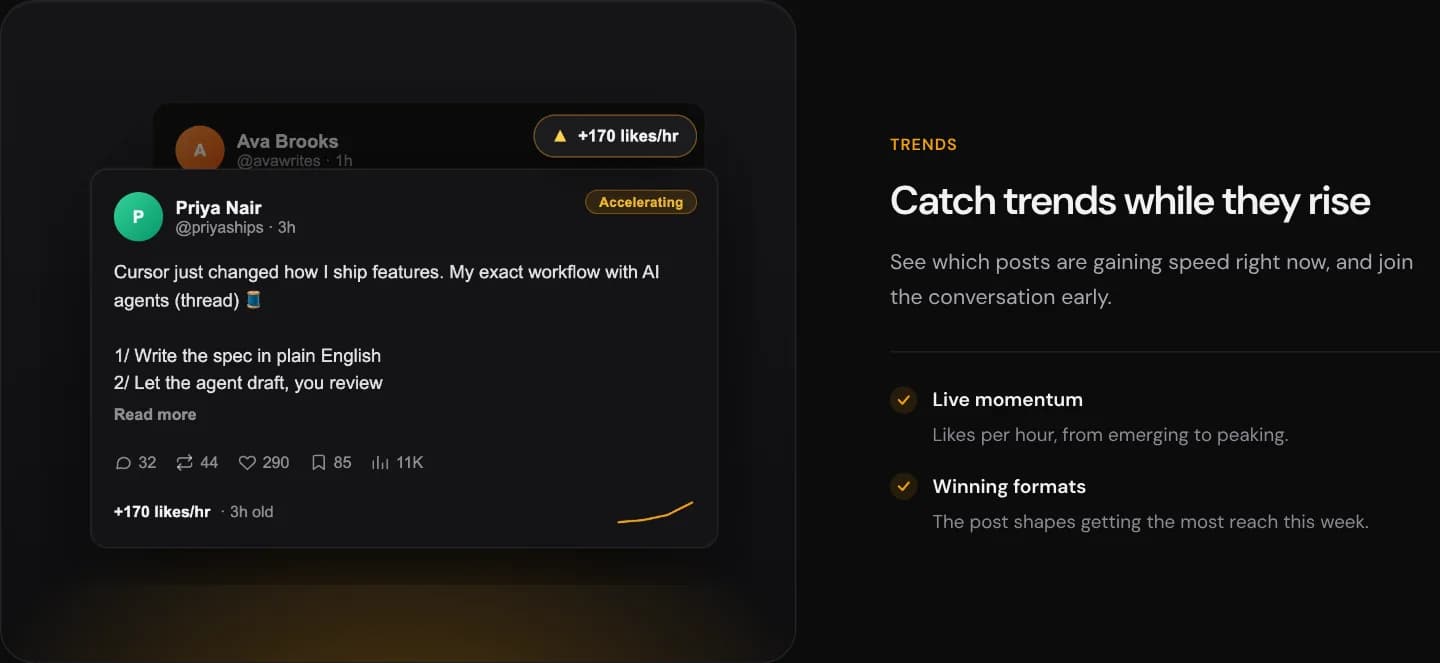
surfaces what's picking up momentum so you can join conversations early.
Voice
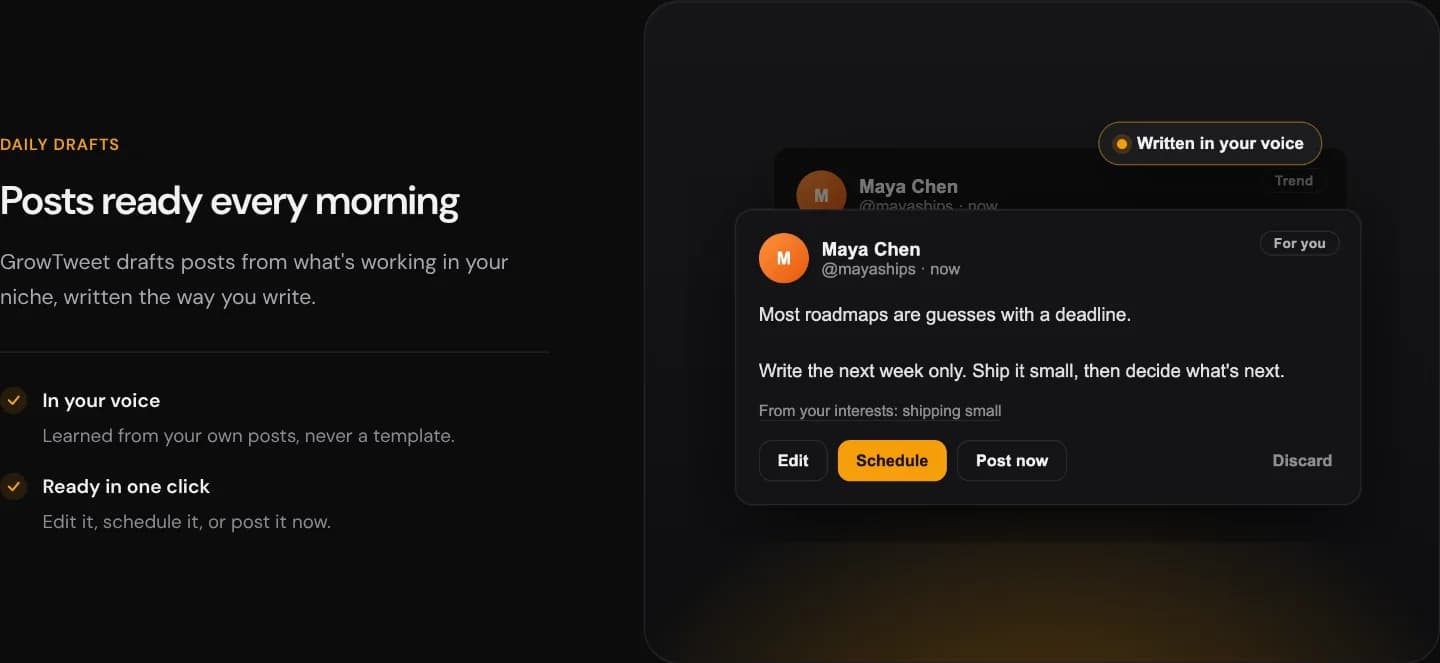
learns how you write, so the posts sound like you and not like a chatbot.
Posts
gives you a feed of ready-to-go drafts based on your interests, trends, proven formats and your own products. You can edit, schedule, post now or discard each one.
Autopilot
handles the scheduling, and Workspaces let you manage more than one account.
The difference is that it connects research and writing in one loop. Most tools do one or the other.
“The difference is that it connects research and writing in one loop.”
04
How is the business doing today?
It's very early. GrowTweet launched in October 2026, and I'm a solo founder. Since launch I've been using it to grow my own X account, which has picked up new followers, and I've had conversations with a handful of potential users.
I'm keeping costs close to zero. The backend runs on Supabase's free plan, and I only upgrade infrastructure once real users show up.
05
What has worked well so far?
Using my own product in public has worked best. When I grow my own account with GrowTweet, the account itself becomes the demo. People see the posts, ask what I'm using, and that starts conversations with potential users.
Building in public on X also works because the audience I want is already there. Indie makers and founders are exactly the people who want to grow on X.
What surprised me is that people care more about what to post than about how to schedule it. Discover and the voice-matched drafts get far more interest than Autopilot does.
“People care more about what to post than about how to schedule it.”
06
What has been challenging?
Distribution, which is ironic given what the product does. Building the features was the easy part. Getting the first people to trust a new tool with their X account is much harder.
“Distribution, which is ironic given what the product does.”
I also build several products at once (templates, Sharos, and another SaaS), and splitting my focus is a constant struggle. Early on I probably built too much before talking to users: credits, workspaces, autopilot and plans were all in place before anyone had signed up. If I did it again I'd launch with Discover and voice-matched posts only and add the rest once people asked for it.
Being based in Bangladesh adds some friction too. Payments and payouts aren't straightforward from here. I run a UK-registered company to handle Stripe.
07
What are your goals, and what does success look like for you?
I'm aiming for a profitable, bootstrapped lifestyle business. I'm not planning to raise money. In 1 to 3 years I'd like GrowTweet to be a reliable source of recurring revenue that, together with my template business, gives me full independence to keep building what I want.
It would feel worth it if indie makers could point to GrowTweet as the reason their audience grew, and if I built a meaningful business from Bangladesh, entirely on my own terms.
08
How did you get your first customers?
My first users came from my own X account. I used GrowTweet to post consistently and shared the build process along the way, and the people who engaged with that became my first leads. I reached out to them directly and talked to them one-on-one.
09
How do you market your product today?
Almost everything happens on X right now. I build in public, post daily (with GrowTweet's help), reply in founder and indie maker conversations, and DM people who show interest. That channel does nearly all the heavy lifting.
I also have a YouTube channel, Artifactal AI, which I plan to use for tutorials and walkthroughs. My template business has an existing audience I can cross-promote to. Paid ads are zero for now. My spend is time on X.
10
What's your single best-performing marketing move so far?
Dogfooding in public. I treat my own X account as the case study: I post with GrowTweet, share the results openly, and let the growth sell the product.
“Dogfooding in public.”
11
How do you keep customers once you've got them?
It's still early, but the product is built around habit. Every time you open it, the Posts feed has fresh drafts based on what's trending in your niche. That keeps the daily value obvious. The credits model lets people top up as they need, and I talk to early users directly so I can fix what bothers them quickly. I'm also building a growth analytics dashboard that will give users insights and specific tips for organic growth, so they can see their progress and keep improving.
12
What's your tech stack?
- 01Backend, database and auth: Supabase
- 02Payments: Stripe
The hardest technical part was voice matching. It's easy to generate generic posts, but much harder to generate posts that sound like a particular person.
13
How do you use AI?
Yes, in both places. I used AI coding assistants heavily to build GrowTweet, which let a solo developer ship a full-featured SaaS quickly. AI is also central to the product: it analyzes your writing style and generates posts from trends, viral formats and your interests.
Over the next few years I think AI will make content nearly free to produce, so the real advantages will be taste, timing and authenticity. Tools that help people sound more like themselves and act on real signals will win. Tools that just produce more generic content will get filtered out.
“The real advantages will be taste, timing and authenticity.”
14
What advice would you give someone who wants to build something of their own?
Think about distribution before you write a line of code. Ask how the first 100 people will find out about it. Launch smaller than feels comfortable, and talk to users before building the "complete" version. And use your own product publicly if you can, because it's the most honest marketing there is.
“Think about distribution before you write a line of code.”
If I started again tomorrow, I'd ship a much smaller version sooner and spend the saved time talking to users.
15
Any resources you'd recommend?
- The book Atomic Habits
16
Where can people find you?
17
Anything else?
If you're an indie maker who keeps saying "I should post more," try GrowTweet and DM me on X. I read every message and I'm building the roadmap around what early users ask for. A growth analytics dashboard with practical tips for organic growth is coming next.
At a glance
- Founder
- Shahin
- Based in
- Dhaka, Bangladesh
- Launched
- October 2026
- Team
- Solo, bootstrapped
- Pricing
- From $29/month, 1-day free trial
- Built with
- Supabase and Stripe
- Also runs
- Studio KOVA, 55+ Webflow and Framer templates
- Also builds
- Sharos, an Android study app
Are you a maker?
Tell us how you make, host and market what you build.
We feature independent makers and small teams — the wins, the mistakes and the lessons in between. If you've shipped something, we'd like to hear about it.